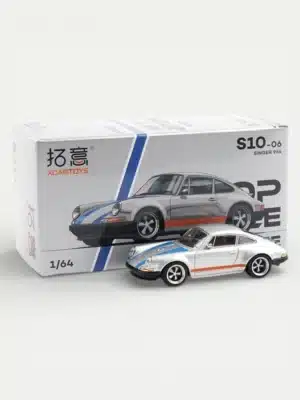
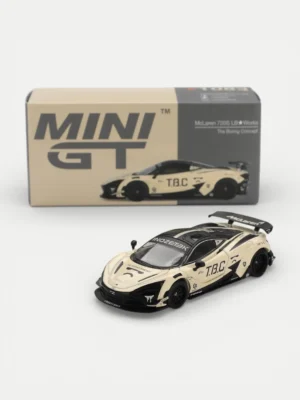
Keep It Mint: How to Display, Clean & Protect Your Model Cars

Welcome to Part 5 of our Ultimate Beginner’s Guide. In the previous chapters, we navigated the complex world of scales, materials, and brands. But now that you’ve spent time and money building your collection, your role is shifting. You are no longer just a hunter; you are a guardian.
Don’t let bad habits ruin your hard work. Today, we tackle the unglamorous but essential side of the hobby: maintenance. Proper display isn’t just about protection—it’s about respect for the machine. From fighting off dust and UV damage to choosing the perfect cabinet, this guide will help you curate a display that preserves both the value and the joy of your collection, ensuring your models look as good in ten years as they do today.
Maintenance 101: 4 Common Mistakes That Devalue Collections
Even experienced collectors can make mistakes in the heat of the moment. Here are four common dos and don’ts of model car maintenance to keep in mind.
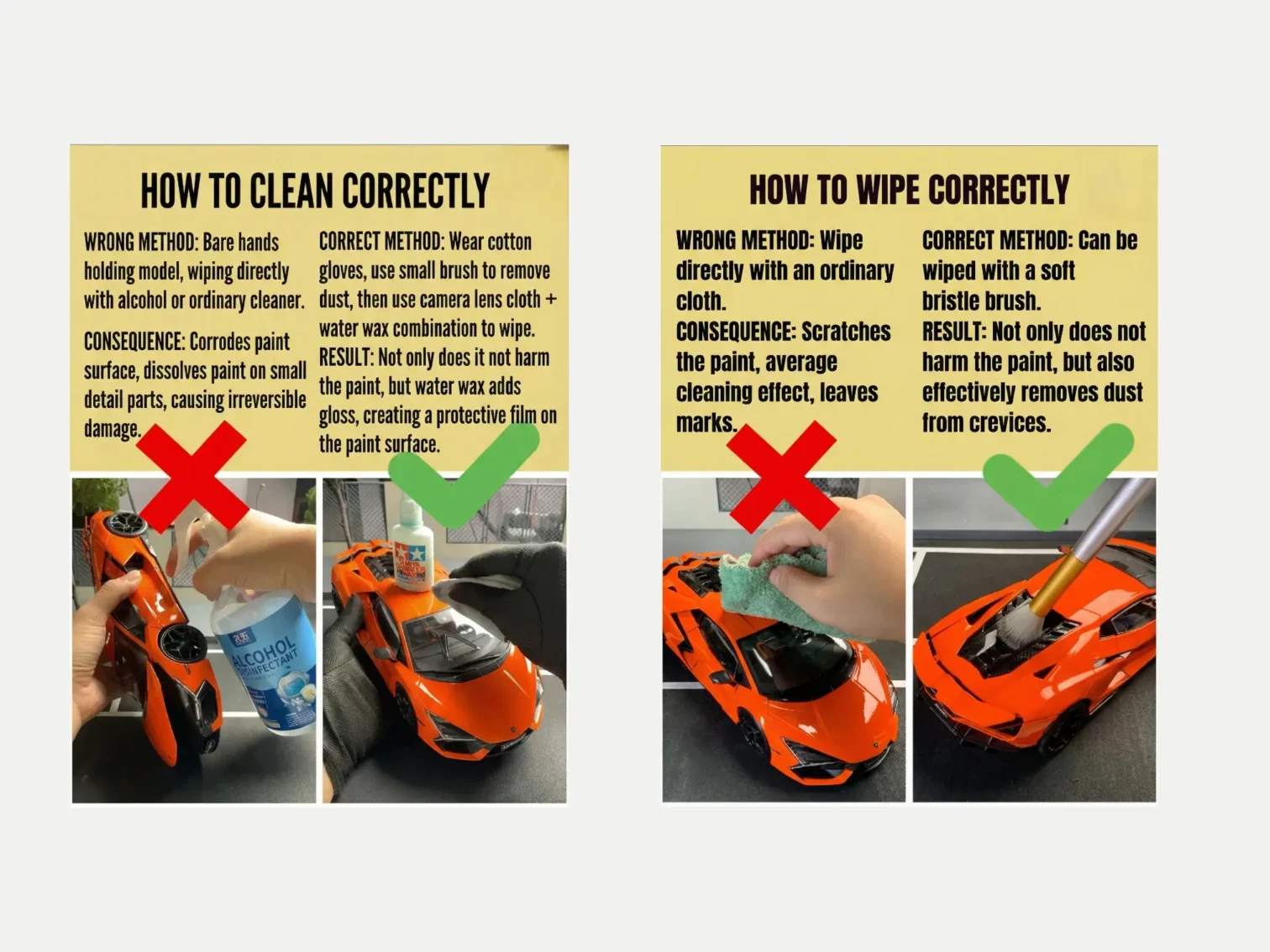
❌ Mistake #1: Handling with Bare Hands
- The Issue: Our fingers naturally carry oils and sweat. Over time, these can smudge the paint and potentially leave permanent fingerprints or marks on delicate finishes.
- The Better Approach: Try to handle models by the main body or the chassis underneath. For the best protection, wearing cotton gloves is a simple habit that keeps the paint pristine.
❌ Mistake #2: Cleaning with Alcohol or Household Cleaners
- The Issue: Harsh chemicals can be disastrous for models. They can dissolve water decals (tampos), dull the clear coat, or damage plastic windows.
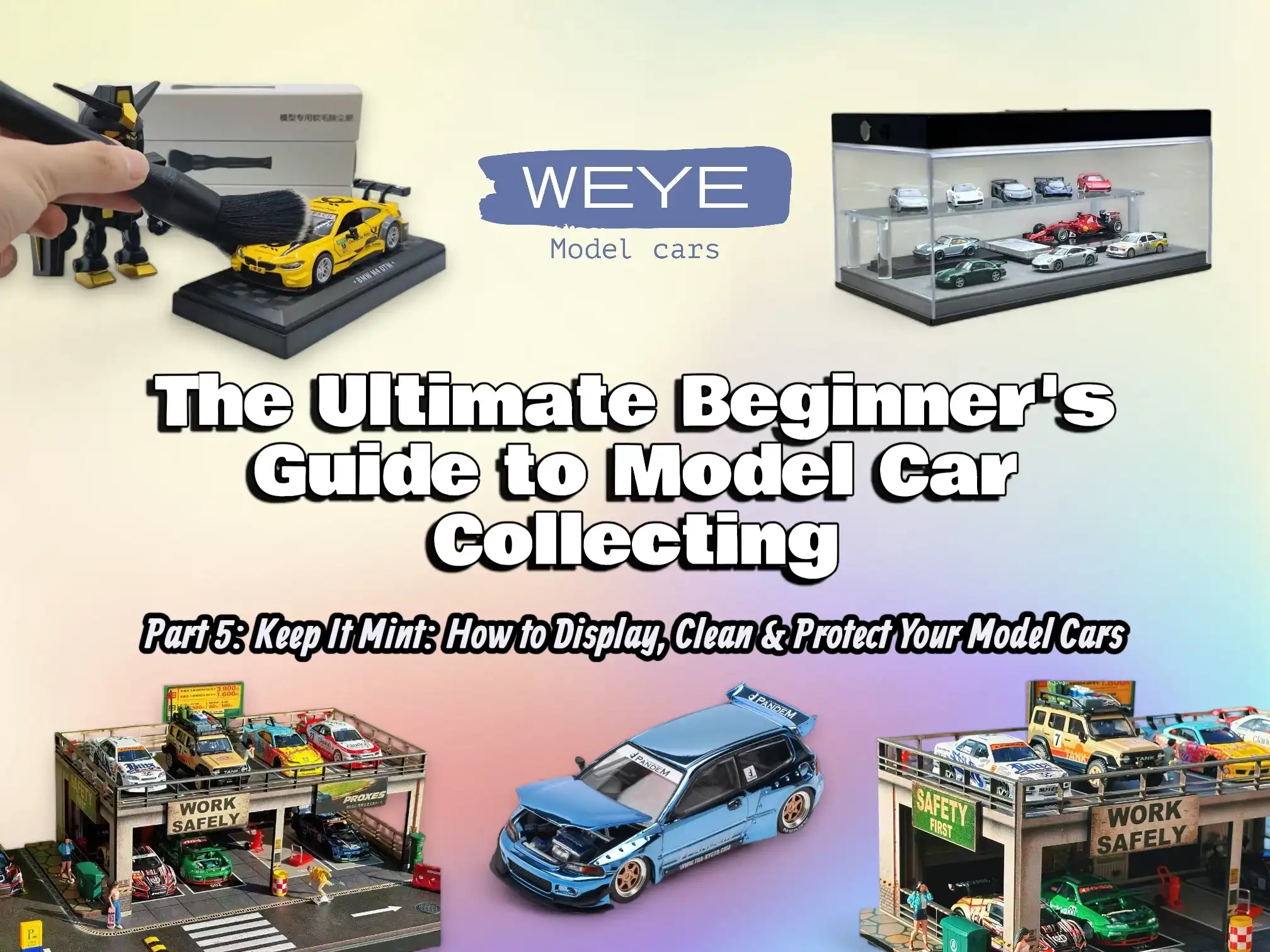
- The Better Approach: For loose dust, a soft, clean makeup brush is the best tool, as it reaches crevices without force. A can of compressed air (used for electronics) is also effective for “touchless” cleaning, provided you use short bursts from a safe distance. For fingerprints, a gentle wipe with a clean microfiber cloth is usually sufficient.

❌ Mistake #3: Leaving Models “Naked”
- The Issue: Leaving models exposed on an open shelf invites dust buildup that is hard to remove later. It also exposes them to humidity changes that can damage packaging.
- The Better Approach: Give the car a “home.” An acrylic cover or a glass cabinet isn’t just for aesthetics; it’s a necessary shield.
❌ Mistake #4: Lifting by the Wrong Parts (Mirrors & Spoilers)
- The Issue: It is a natural instinct to grab a car by the roof or wing, but putting pressure on fragile parts like side mirrors, spoilers, and antennas is the fastest way to snap them off.
- The Better Approach: Always pick up the model by the main body shell or cup the chassis from underneath. Treat the small appendages as “look but don’t touch” zones.
Organizing Your Display: The Visual Power of a Theme
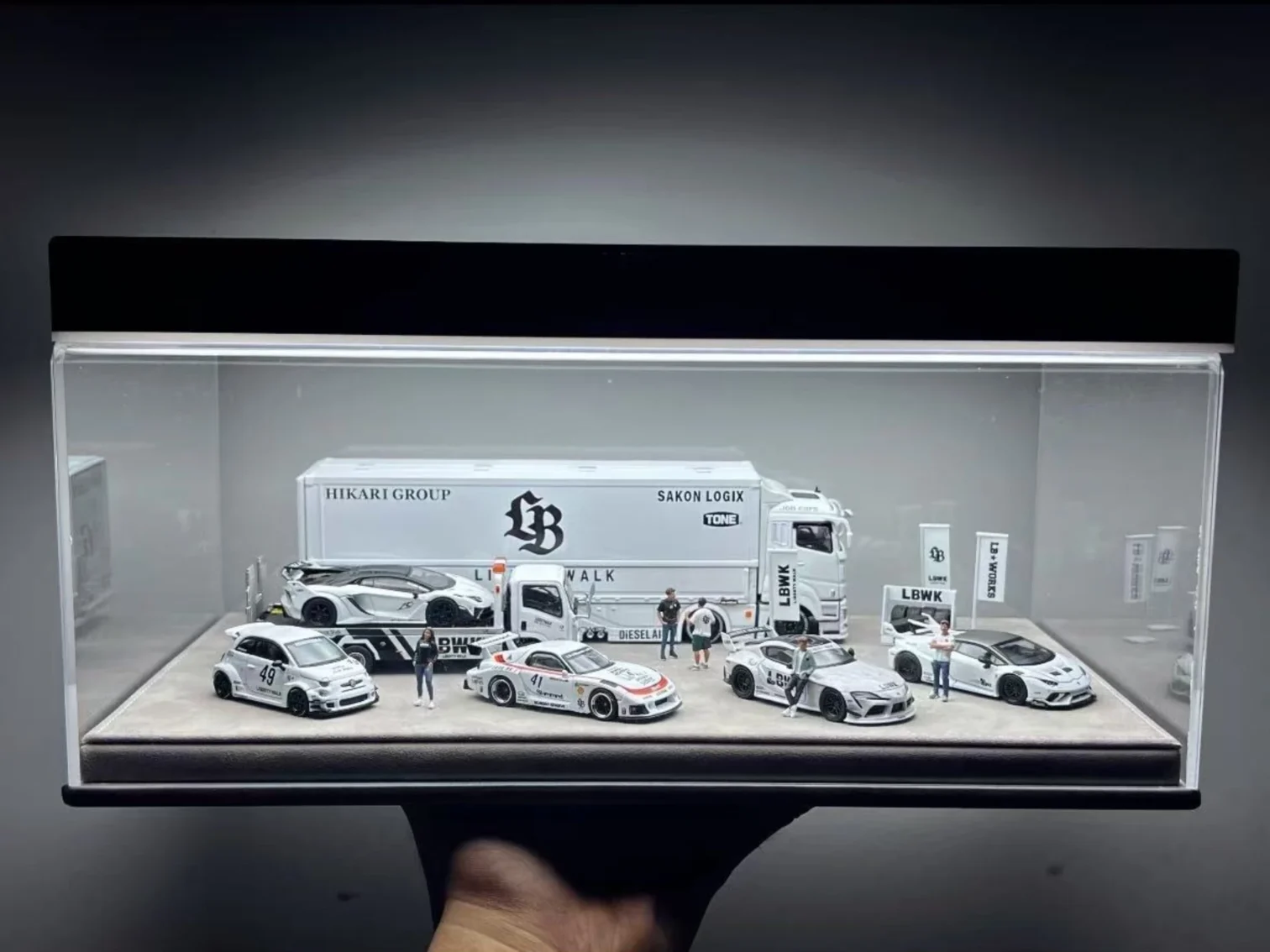
Handling is about safety; arrangement is about impact. There is a fine line between a stunning collection and a messy parking lot. That line is organization. If you just line up cars randomly, they get lost in the crowd. But with a little strategy, even a small collection can look like a high-end museum exhibit.
To make your collection visually stunning, try grouping your models by theme within your display case. This creates a sense of cohesion and professionalism.
Group by Marque: Dedicate one shelf exclusively to Porsche or Ferrari to show their evolution.
Group by Era: Arrange your 1960s American muscle cars together to capture the spirit of a decade.
Group by Color: A visually striking technique is to arrange cars by color gradient, regardless of make.
Create a “JDM Corner”: Keep your Japanese imports together to create a focused, culturally distinct section in your cabinet.
Giving Your Cars a Home: The Best Way to Fight Dust & UV
Even the most beautifully arranged collection can be ruined by the environment. Leaving models on an open shelf is essentially exposing them to a slow-motion disaster. To keep your cars looking showroom-fresh, you must defend them against the ‘Big Three’ enemies:
- Dust: An accumulation of dust ruins the appearance of a model and is notoriously difficult to clean from tiny crevices.
- Sunlight (UV Rays): This is perhaps the most dangerous enemy. Prolonged exposure to direct sunlight will fade paint, turn plastic parts brittle, and yellow clear window parts.
- Humidity: High moisture can damage cardboard packaging and, in extreme cases, cause metal diecast models to develop “zinc pest” (a form of corrosion).
The Defense Strategy: Enclosed Cabinets
To solve this, we recommend creating a “sealed environment”:
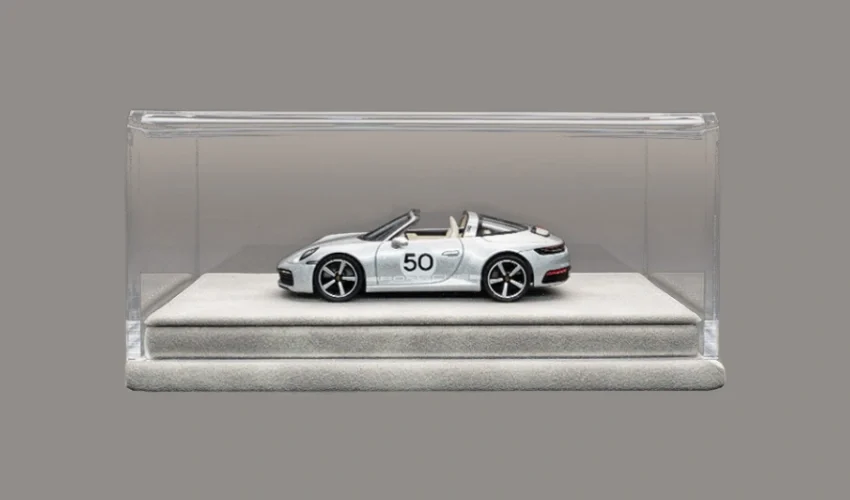
- Acrylic Cases: For 1:64 scale or single special models, individual acrylic cases are perfect. They offer dust-free protection and are stackable.
- Glass Cabinets: For larger collections, an enclosed glass-door cabinet is one of the best display cases for 1:18 scale models. The IKEA DETOLF is a favorite among collectors because it protects the collection while keeping it fully visible.
The Humidity Solution: Silica Gel
Humidity is the silent killer. Even inside a glass cabinet, moisture can seep in.
The Fix: Place small packets of silica gel (desiccant) in the back corners of your display cabinet or inside your storage boxes. They are inexpensive, easy to hide behind models, and actively absorb moisture to keep your collection dry and safe from oxidation.
The Lighting Rule: LEDs Only
Lighting makes a collection pop, but heat is a killer.
Avoid: Halogen bulbs or direct sunlight.
Use: Low-heat LED light strips. They provide bright, neutral light without the damaging heat output.
Leveling Up: Bringing Your Collection to Life with Dioramas
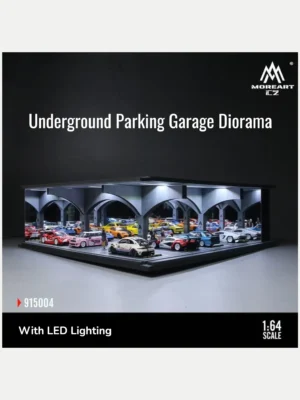
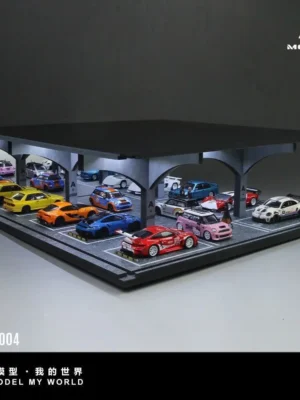
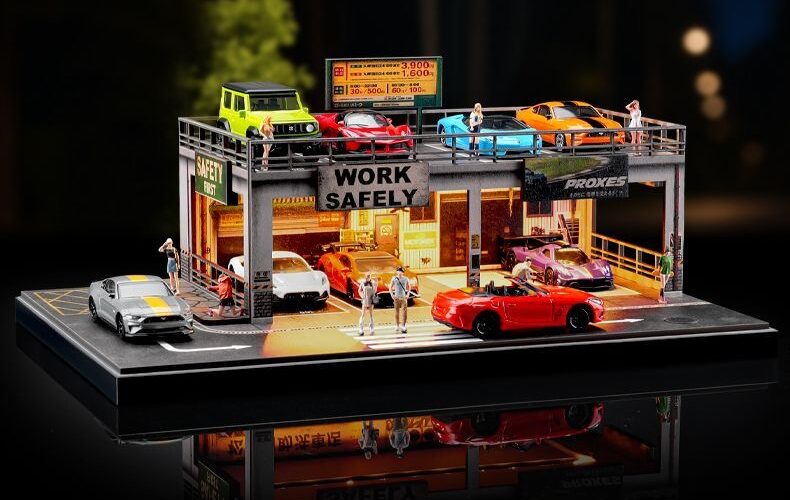
Let’s be honest: rows of cars lined up on a glass shelf can sometimes look like a crowded parking lot. If you want your collection to stop people in their tracks, you need context. Adding a diorama doesn’t just display the car; it captures a moment in time.
Match the Vibe: Don’t just buy any scene; match it to your theme. A clean, LED-lit showroom diorama makes a Ferrari look expensive, while a gritty, graffiti-covered street corner brings a JDM drift car to life. The background tells the viewer where the car belongs.
The “Scale” Effect: A car sitting alone is just an object. But place a tiny mechanic fixing a tire, or a driver holding a helmet next to it, and suddenly the realism explodes. This is where brands like MoreArt shine—their figures provide the necessary size reference that tricks the eye into thinking it’s looking at a real car, not a toy.
Unlock Desktop Photography: Once you have a scene and figures, you have a photo studio. You don’t need a professional camera; the lighting and detail from a good diorama setup allow you to take cinematic car photos right from your smartphone.
Packaging & Resale Value: Should You Keep Diecast Model Boxes?
It’s the dilemma every collector faces eventually: your display cabinet looks amazing, but your closet is overflowing with empty cardboard boxes. Is it really worth the storage space to keep them? The short answer is: Yes.
From a financial standpoint, the original packaging is not just cardboard; it is a crucial part of the asset. In the collector market, a model listed as “Mint in Box” (MIB) can command a price 20% to 50% higher than the exact same model sold “loose” (without a box).
For Investment: If you are collecting high-end brands like AUTOart or Motorhelix, the box (and the certificate of authenticity inside) is non-negotiable. Throwing it away is like throwing away cash.
For Protection: Beyond money, original boxes are engineered to hold the car perfectly. If you ever move house or decide to sell and ship the model, nothing protects it better than its original “shell.”
The Exception: If you are collecting entry-level models purely for the joy of display, have zero intention of selling, and are extremely tight on storage space, then—and only then—might you consider recycling them. But for everything else? Flatten them, store them, keep them.
Model Car Care & Maintenance Cheat Sheet
Use this quick reference table to keep your collection in top condition.
| Category | The Enemy | Best Solution | Collector’s Habit (Do) | Common Trap (Don’t) |
|---|---|---|---|---|
| Handling | Finger Oils | Cotton Gloves | Hold by chassis/tires only. | Touching paint; grabbing by the spoiler. |
| Display | Dust & UV | Acrylic Case / Cabinet | Use low-heat LED lighting. | Direct sunlight; hot halogen bulbs. |
| Cleaning | Dust Buildup | Soft Makeup Brush | Use air blower for crevices. | Household cleaners; coarse rags. |
| Storage | Value Loss | Original Box | Store boxes in dry area. | Throwing away packaging. |
Final Thoughts: From Buyer to Curator
Congratulations! You have completed our Ultimate Beginner’s Guide. We have journeyed through the difference between toys and models, the science of materials, the importance of scale, the hierarchy of brands, and finally, the art of preservation.
However, reaching the end of this guide doesn’t mean the road ends here. We will continue to update our blog with deeper collecting knowledge, the fascinating history behind specific models, and detailed hands-on reviews.
Collecting is a journey, not a race. Whether you have one perfect 1:18 scale supercar or a wall of one hundred 1:64 scale racers, the joy comes from the connection to the machine.
Ready to start your curated collection? Visit us at Weye Model Cars to find your first piece. Happy collecting!








![[PRE-ORDER] INNO64 1:64 Nissan Skyline GT-R (R32) Midnight Purple - Australia Special Edition (Limited)](https://weyemodelcars.com/wp-content/uploads/2026/01/inno64-skyline-gtr-r32-midnight-purple-australia-special-edition-poster-300x400.webp)