Welcome to Part 3 of the Ultimate Beginner's Guide, presented by Weye Model Cars. This week: Finding your scale.
Welcome to Part 3 of our Beginner’s Guide! In our last chapter, we dissected the materials that give a model its soul. Now, we tackle what is arguably the most critical decision a new collector must make: choosing a scale.
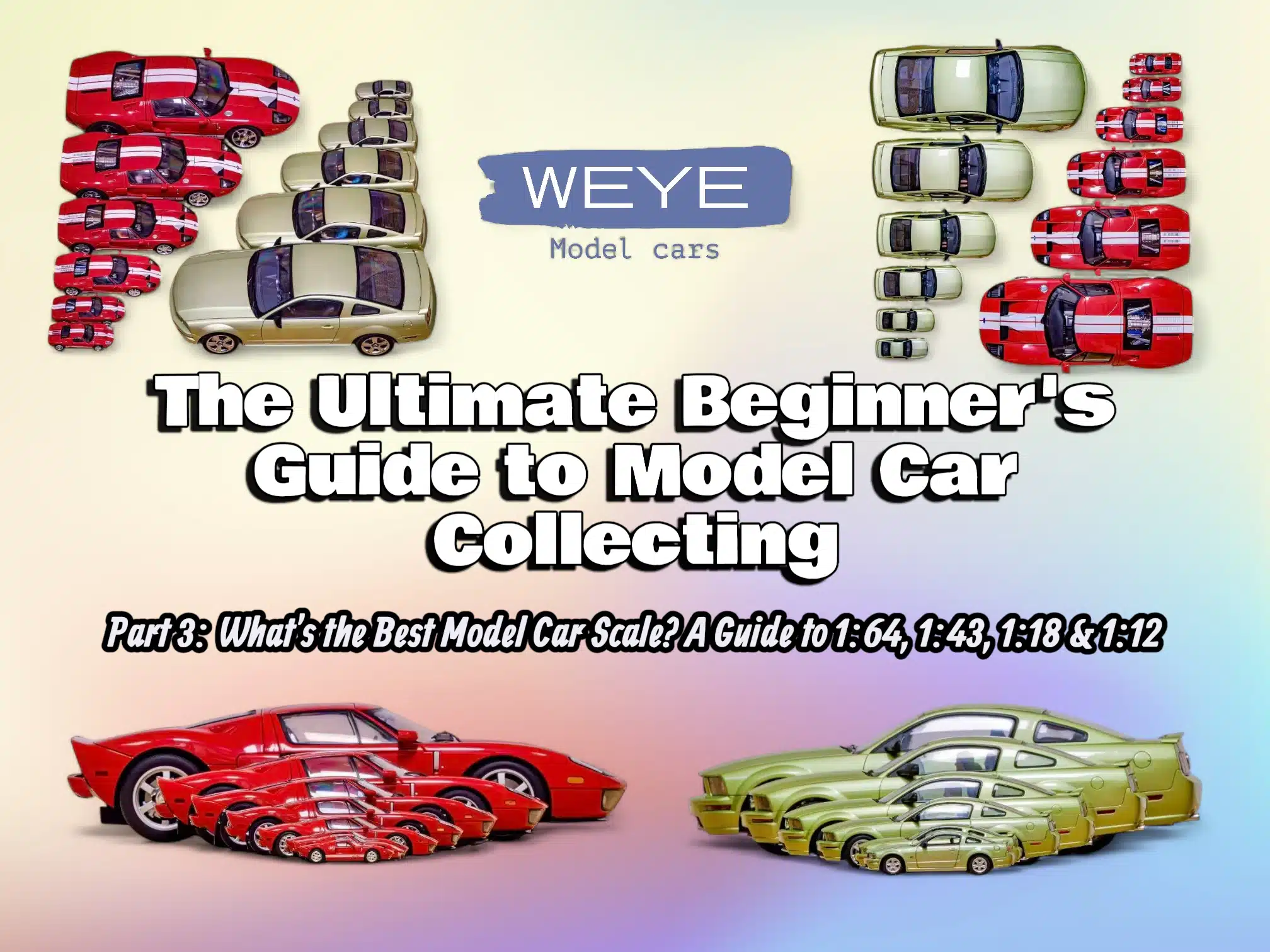
A model’s scale is its size relative to the full-size car it replicates, expressed as a ratio (e.g., 1:18 or 1/18). This means the model is 18 times smaller than the real vehicle. It’s a fundamental choice that dictates your cost, the level of detail you can expect, and the physical space your collection will occupy.For those new to the hobby, here is the most important rule for understanding model car scales explained: the smaller the number after the colon, the larger the model car will be. A 1:18 scale model is much larger than a 1:64 scale model.
Let’s explore the most popular scales to help you find your focus.
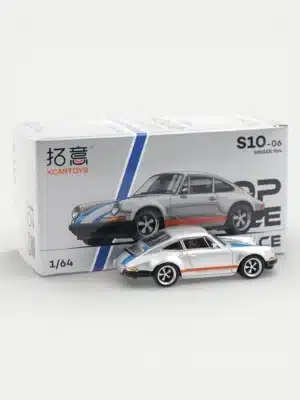
1:64 Scale (The Pocket-Sized Universe)
Size: Approx. 3 inches / 7-8 cm
Historical Context: The 1:64 scale is now mainstream, but it’s a relatively new concept. It evolved from “accessory production” rather than a set rule. In 1953, Lesney launched Matchbox with the simple rule that the car had to fit inside a matchbox, which led to the “pocket cars” concept. Later, in 1968, Hot Wheels designed its cars to fit a standard track system, which fixed their width. This meant early cars were all different scales to fit one box size. Brands like Tomica later began stamping the correct scale on the chassis, and the hobby slowly standardized around the 1:64 concept.
Pros: This scale’s greatest advantages are its space efficiency and affordability. You can build a massive, diverse collection without needing a dedicated room. The price point, even for premium brands, makes it the best model car scale for beginner collectors who want to explore different cars without a huge financial commitment.
Cons: The small size creates a physical limit to the level of detail. Quality also varies dramatically between a $1 toy and a $30 premium collectible.
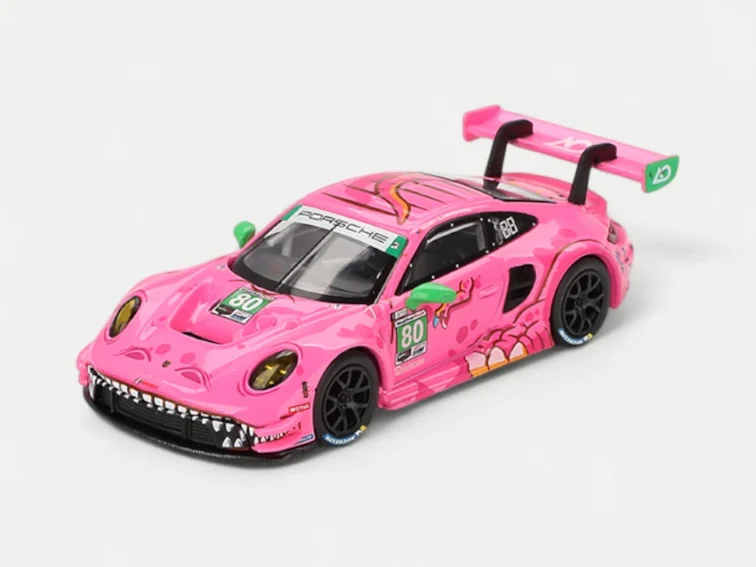
MINI GT 1:64 Scale Model – Porsche 911 GT3 R “Roxy”
1:43 Scale (The Global Standard)
Size: Approx. 4-5 inches / 10-12 cm
Historical Context: This is the most mainstream and historically longest-running scale, and its origin is directly linked to model railways. In 1934, Meccano (UK) launched Dinky Toys. To make their cars compatible with the popular “O” gauge model trains (which were 1:43.5 scale in Europe), Dinky chose the nearby 1:43 ratio in 1951. They established this as the industry standard, which is why it’s not a round number.
Pros: This is the “golden mean” of collecting, offering an ideal balance of detail and size. It’s large enough for a realistic interior but small enough to be space-efficient. This scale boasts the widest and deepest catalog of available subjects, especially for European cars and motorsports history.
Cons: The market for new 1:43 street cars has seen some decline as manufacturers focus on the booming 1:64 and high-margin 1:18 markets.
1:24 Scale (The American Favorite & Builder’s Choice)
Size: Approx. 7-8 inches / 18-20 cm
Historical Context: In the United States, this scale (along with its close cousin, 1:25) became hugely popular when US companies began releasing plastic model kits in the 1950s and 70s. The scale is based on the imperial system, where 1 real foot equals about 1/2 inch on the model. Its convenient size made it a favorite for both detailed kits (like those from AMT) and durable toys.
Pros: It offers a noticeable step up in “shelf presence” from 1:43. It is the dominant scale for plastic model kits, making it the default choice for hobbyists who enjoy building and painting. The selection of classic American muscle cars is particularly strong.
Cons: For pre-assembled diecast collectors, 1:24 can feel like an awkward middle ground. It often lacks the encyclopedic variety of 1:43 and the ultimate detail of 1:18.
Brand Tiers:
Entry-Level (Diecast):Maisto, Bburago, Jada Toys
Collector-Grade (Kits):Tamiya, Aoshima , Revell
Top-Tier (Diecast): Franklin Mint (Vintage)
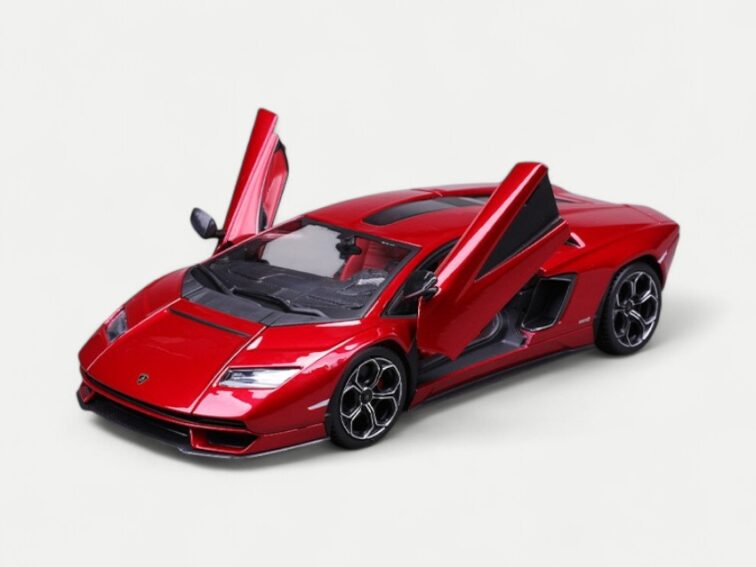
Bburago 1:24 Scale Model – Lamborghini Countach LPI 800-4
1:18 Scale (The Connoisseur’s Centerpiece)
Size: Approx. 10-12 inches / 25-30 cm
Historical Context: This scale only became popular in the mid-1970s. Its origin is a bit of a mystery and not based on a simple calculation. It’s based on an imperial conversion: 1 real foot is roughly 2/3 of an inch on the model. The leading theory is that it was a compromise, designed to be large enough for impressive detail and opening parts, but not too large for shelf display.
Pros: This is the largest of the mainstream scales, prized for its commanding presence. The large size allows for a breathtaking level of detail: fully replicated engines, intricate interiors, working steering, and even functional suspension. Nearly all 1:18 models feature a full suite of opening parts.
Cons: The two biggest drawbacks are space and cost. These models are “shelf hogs” and require significant display real estate. This is the core of the 1:18 vs 1:43 scale model car comparison—do you want one large, perfect model, or four smaller ones?
Top-Tier (Premium):AUTOart, BBR, CMC (Classic Model Cars)
LCD Models 1:18 Scale Model – Pagani Utopia
1:12 Scale (The Ultimate Statement Piece)
Size: Approx. 15-18 inches / 38-45 cm
Historical Context: The origin of 1:12 scale comes directly from the British imperial system. It is known as “One Inch Scale,” meaning 1 real foot is represented by 1 model inch (a 1:12 ratio). This scale was already widely used in dollhouses and architectural models. Because it was compatible with 6-inch action figures (also 1:12), many Asian brands began developing 1:12 kits for export in the 1970s and 80s. Today, it has become a mainstream scale for highly detailed motorcycle models.
Pros: This is not just a model; it’s a piece of furniture. 1:12 scale models are the ultimate “statement piece,” offering a level of detail that is simply breathtaking. You will often find mixed-media construction, including real leather, fabric seatbelts, and intricate wiring. Their sheer size gives them an unmatched presence.
Cons: This scale is for the collector with significant space and budget. Models are extremely expensive, often costing many hundreds or even thousands of dollars. The selection of available cars is also very limited, focusing only on the most iconic supercars and classic racers.
To understand the advantages and disadvantages of different model car scales, here is a simple comparison chart.
Scale
Approx. Size
Average Cost
Key Brands
Best For…
1:64
3 in / 7.5 cm
$1 – $40
Hot Wheels, MiniGT, TLV
The “Archivist” (space-efficient, broad collection)
1:43
4-5 in / 10-12 cm
$20 – $150
Spark, Minichamps, Norev
The “Curator” (thematic, motorsports history)
1:24
7-8 in / 18-20 cm
$15 – $80
Maisto, Bburago, Tamiya (Kits)
The “Builder” (plastic kits, American muscle)
1:18
10-12 in / 25-30 cm
$40 – $400+
AUTOart, LCD Models, CMC
The “Connoisseur” (maximum detail, centerpiece)
1:12
15-18 in / 38-45 cm
$300 – $2000+
CMC, Amalgam, Tamiya (Kits)
The “Patron” (ultimate statement piece, museum-quality)
Conclusion: How to Select Your Scale
There is no single “best” scale. The right choice is a personal balance between your budget, your available display space, and your desire for detail.
Choose 1:64 or 1:43 if: You have limited space, are on a budget, or want to build a large, thematic collection (like every car from a racing series).
Choose 1:24 if: You are primarily interested in building plastic model kits or have a passion for classic American muscle cars.
Choose 1:18 if: You are a “quality over quantity” collector. You prefer to have fewer models, but want each one to be a highly detailed centerpiece with full opening features.
Choose 1:12 if: You have significant space and budget, and you want a single, museum-quality masterpiece to be the focal point of a room.
The best way to find your focus is to explore them. We invite you to browse our shop at Weye Model Cars, where you can filter our entire collection by 1:18 Scale, 1:43 Scale, and 1:64 Scale to see what speaks to you.
Stay tuned for Part 4, where we will do a deep dive into the most popular model car brands!






![[PRE-ORDER] INNO64 1:64 Nissan Skyline GT-R (R32) Midnight Purple - Australia Special Edition (Limited)](https://weyemodelcars.com/wp-content/uploads/2026/01/inno64-skyline-gtr-r32-midnight-purple-australia-special-edition-poster-300x400.webp)



%20Customized%20Version%20–%20Purple%20(Resin,%20Limited%20199)&url=https://weyemodelcars.com/product/motorhelix-118-nissan-skyline-gt-r-r32-customized-version-purple-resin-limited-199/&media=https://weyemodelcars.com/wp-content/uploads/2026/01/motorhelix-1-18-nissan-skyline-gtr-r32-customized-purple-limited-edition-791x1024.webp)
%20Midnight%20Purple%20–%20Australia%20Special%20Edition%20(Limited)&url=https://weyemodelcars.com/product/pre-order-inno64-164-nissan-skyline-gt-r-r32-midnight-purple-australia-special-edition-limited/&media=https://weyemodelcars.com/wp-content/uploads/2026/01/inno64-skyline-gtr-r32-midnight-purple-australia-special-edition-poster-791x1024.webp)


