The Story of the Mazda 787B: How a Rotary Engine Conquered Le Mans in 1991
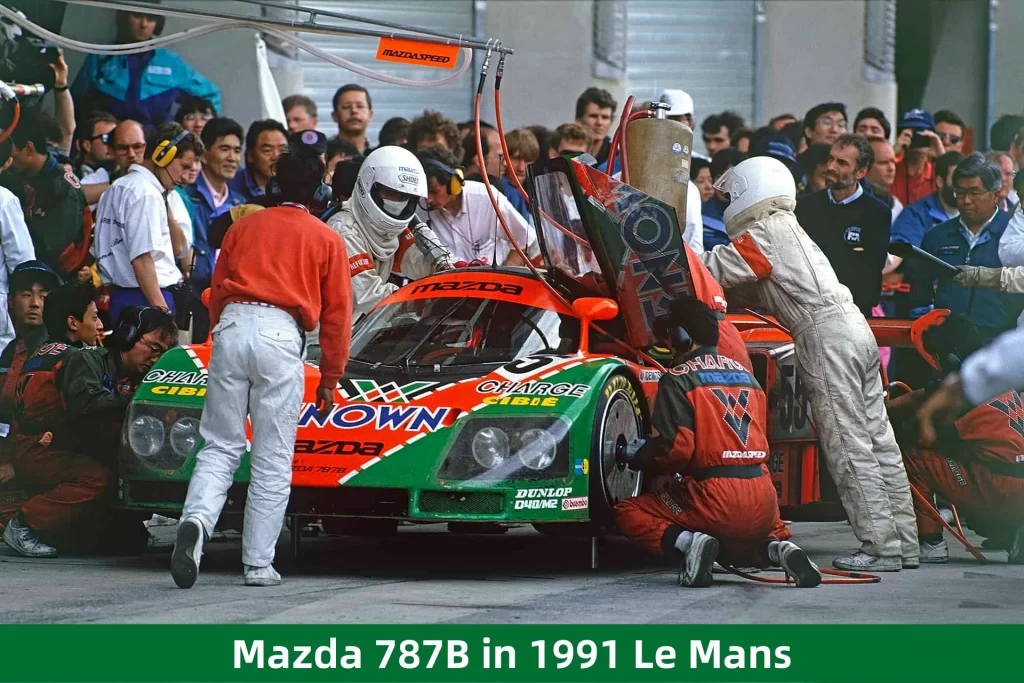
If you stood near the Mulsanne Straight during the summer of 1991, your eardrums were likely shattered by a sound that defied description. It wasn’t the deep, rhythmic rumble of a traditional V8, nor the howling symphony of a V12. It was a violent, high-frequency shriek that tore through the French countryside—the unmistakable battle cry of the 1991 Le Mans winner, the legendary Mazda 787B.
Against a formidable grid dominated by European motorsport royalty like Porsche, Jaguar, and Mercedes-Benz, a small manufacturer from Hiroshima pulled off the ultimate underdog victory. But the story of the Mazda 787B Le Mans triumph is more than just a tale of speed; it is a masterclass in engineering defiance.
The Miracle of the R26B Rotary Engine
To understand the sheer dominance of the 787B, you have to look past its iconic orange and green Renown livery and focus on its beating heart: the R26B rotary engine.
While competitors relied on massive, heavy piston engines, Mazda’s engineers perfected the four-rotor Wankel design. Displacing just 2.6 liters, this naturally aspirated marvel reliably punched out a staggering 700hp under the grueling demands of endurance racing. The secret lay in cutting-edge innovations like peripheral intake ports and continuously variable telescopic intake manifolds, which optimized airflow across the entire rev range.
When the tachometer needle violently swung toward its 9,000 RPM redline, the four rotors fired in perfect symphony. The result was not just that unforgettable scream, but an engine so butter-smooth and relentlessly reliable that it could be pushed to its absolute breaking point for 24 hours straight without a single hiccup.
The 1991 Breakthrough Strategy: Weight, Tactics, and Agility
Raw horsepower alone doesn’t win the world’s toughest endurance race. Mazda’s ultimate weapon in 1991 was extreme lightness.
Built around a carbon fiber and Kevlar composite monocoque, the 787B weighed a featherlight 830kg. Crucially, due to transitional Group C regulations that year, rivals like the TWR Jaguar XJR-12 and the Porsche 962 were slapped with massive weight ballast penalties. Mazda’s rotary-powered machine cleverly bypassed these restrictions, giving it a monstrous power-to-weight advantage that allowed it to carve through corners like a scalpel.
Under the strategic genius of six-time Le Mans champion Jacky Ickx acting as an advisor, the driver lineup of Volker Weidler, Bertrand Gachot, and Johnny Herbert executed a flawless race. They maintained blistering lap times while strictly managing the race’s draconian fuel consumption limits.
The climax of the race remains one of motorsport’s most heroic moments. To protect their hard-fought lead, Johnny Herbert 787b stayed in the blistering hot cockpit for a punishing final stint. Pushing his body to the absolute limit, a severely dehydrated Herbert crossed the finish line to cement the victory, only to collapse from exhaustion immediately after, forcing him to miss the podium celebration.

Why Was the Mazda 787B Banned? The Truth Behind the Rotary Myth
The short answer: The Mazda 787B was not banned for being “too fast” or to deliberately target the rotary engine. It was retired because of a pre-planned FIA regulation change for the 1992 season, which mandated that all top-tier Group C cars use 3.5-liter naturally aspirated piston engines—effectively rendering the 787B’s 2.6-liter quad-rotor engine illegal.
To fully understand this historic shift, we need to separate the popular urban legend from the technical and political realities of early 90s motorsport.
The Urban Legend: “Too Fast for the Competition”
For decades, a myth has persisted among gearheads that the FIA panicked after Mazda’s stunning 1991 Le Mans victory. The story claims that European manufacturers pressured the governing body to outlaw rotary technology to protect their own dominance. While it makes for a romantic underdog narrative, it is entirely historically inaccurate. The rule changes that ended the 787B’s career were actually announced years before Mazda ever lifted the trophy.
The Real Reason: The 3.5L Engine Standardization
The true reason behind the “ban” was a broader political and economic strategy by the FIA. In an attempt to cut development costs and align the World Sportscar Championship with Formula 1, the FIA decided to mandate the exact same engine formula for both series: 3.5-liter naturally aspirated engines.
The goal was to entice major manufacturers (like Peugeot, Toyota, and Mercedes) to build one engine block that could be used in both F1 and Le Mans. Because the Mazda 787B relied on the unique R26B four-rotor engine, it simply did not fit into this new, highly specific piston-engine regulatory box.
How Mazda Capitalized on the Final Year
Rather than being the victim of a targeted ban, Mazda was actually the ultimate opportunist. 1991 was a transitional year. The FIA allowed the older Group C cars (like the Porsche 962 and Jaguar XJR-12) to race alongside the new 3.5L generation, but slapped the older cars with massive weight penalties.
However, due to the unique displacement calculations for rotary engines, the 787B was allowed to run at a featherweight 830 kg (1,830 lbs), while its main piston-powered rivals were heavily ballasted up to 1,000 kg. Mazda knew 1991 was the closing of a historical window. They combined phenomenal fuel efficiency, bulletproof rotary reliability, and a significant weight advantage to outlast the competition.
They didn’t get banned for winning; they simply won the rotary engine’s last permitted dance.
Own a Piece of the Screaming Legend
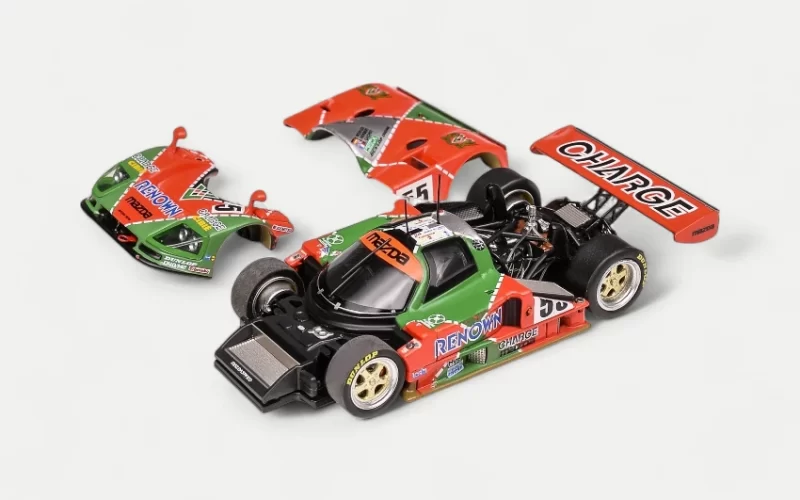
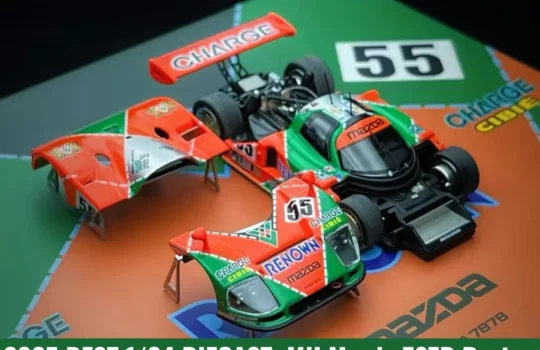
Today, the original #55 chassis rests quietly in a museum in Hiroshima, but its legacy remains firmly etched in motorsport history. For enthusiasts looking to keep a piece of that legend close at hand, the MOTORHELIX 1:64 scale Mazda 787B serves as a fitting tribute.
Far from a simple display piece, this specific collector-grade replica features fully removable body panels. This precise engineering detail allows you to look beneath the iconic Renown livery and admire the intricately recreated R26B 4-rotor engine and the complex Group C chassis layout. It is an interactive, scaled-down piece of motorsport history that perfectly captures the mechanical spirit of the 1991 Le Mans winner.